

WordPress 6.9 shipped the Abilities API. Now the question is which parts of your plugin should use it.
Not all of it. Not even most of it.
The Abilities API is designed for atomic, composable units. Things AI agents can discover, call, and chain. The more focused the ability, the more useful it is.
So what qualifies?
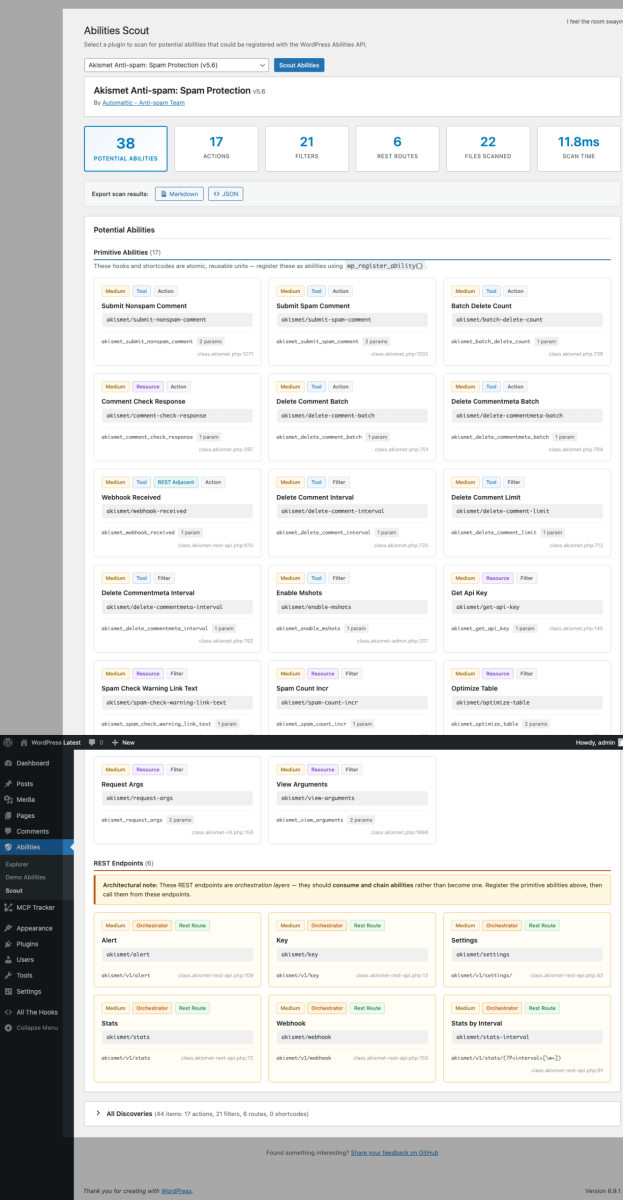
Hooks and shortcodes. Not REST routes.
REST endpoints receive requests, coordinate multiple operations, and return responses. They are orchestrators. The right pattern is: REST endpoint calls abilities, not the other way around.
Abilities Scout v1.2.0 makes this distinction the foundation of its scoring engine.
Hooks score as primitive ability candidates. REST routes are classified as orchestrators and capped at medium confidence by design. Hooks found in the same file as a REST route registration score an extra 20 points because they are likely the primitives that endpoint is already calling.
The export format reflects the same split. Primitives in one section, orchestrators in another, with a clear note on what to register versus what to refactor.
And in v1.2.0, the three core abilities (abilities-scout/scan, abilities-scout/draft, abilities-scout/export) are registered via the Abilities API themselves and confirmed working over MCP on a live WordPress 6.9 site.
What to try
Scan a plugin you maintain. See what lands in Primitives versus Orchestrators. Does it match how you think about the plugin’s internal architecture?
Try the Markdown export with Claude or Cursor. Paste it, say “build these abilities,” watch the stubs give the AI enough grounding to write real code.
If you have MCP connected to a local WordPress 6.9 site, call abilities-scout/scan directly. The agent gets hook names, file paths, and line numbers. From there it can read the source and write full implementations without needing the stubs at all.
Static analysis is a starting point. You still make the architectural calls. But a ranked list of candidates, with source locations, is a faster starting point than reading every file yourself.
Grab v1.2.0 here: github.com/laxmariappan/abilities-scout
Scan something and tell me what it gets right and what it misses. That feedback is how v1.3.0 gets built.
Leave a Reply